
Why the Core Goals Are the Same But the Paths Are Totally Different
Both systems aim to get providers paid accurately and promptly. Yet they diverge because of:
- Distinct insurance policies and coverage philosophies
- Separate coding standards
- Unique claim submission rules
- Varying reimbursement structures
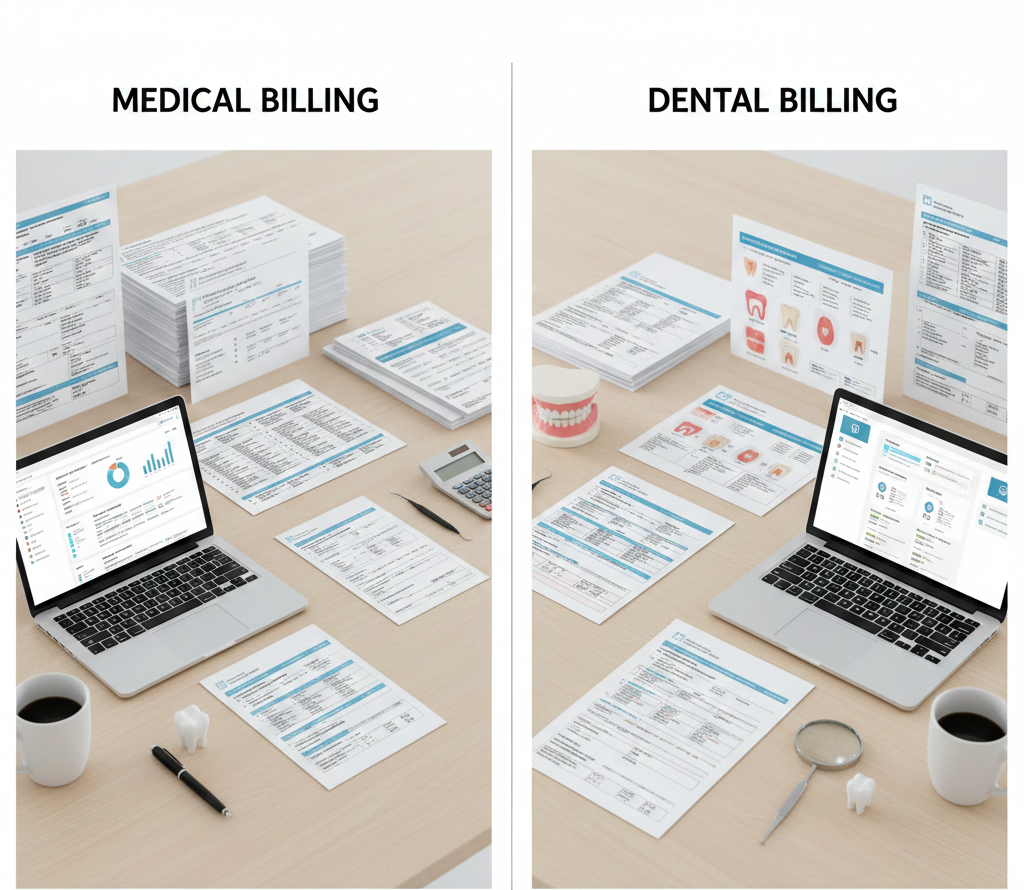
Medical Billing vs Dental Billing: Side-by-Side Comparison
Here’s a clear overview of the major differences:
Aspect | Medical Billing | Dental Billing |
|---|---|---|
| Primary Focus | Whole-body health, disease treatment & prevention | Oral/dental care & procedures |
| Providers | Physicians, hospitals, specialists | Dentists, orthodontists, oral surgeons |
| Main Coding Systems | CPT (procedures), ICD-10 (diagnoses), HCPCS | CDT (Current Dental Terminology) |
| Insurance Basis | Medical necessity | Service categories (preventive/basic/major) |
| Coverage Limits | Usually no strict annual caps | Common annual maximums (e.g., $1,500–$2,000) |
| Claim Complexity | More detailed & complex | Generally simpler |
| Typical Claim Forms | CMS-1500 (professionals), UB-04 (facilities) | ADA J400 Dental Claim Form |
Breaking Down the Coding Systems
Medical Billing Codes
Medical billing uses multiple layers for precision:
- CPT Codes — Describe procedures (e.g., 99213 for a standard office visit).
- ICD-10 Codes — Specify diagnoses (e.g., E11.9 for Type 2 diabetes without complications).
- HCPCS Codes — Cover supplies, equipment, and certain drugs.
Dental Billing Codes
Dental relies almost exclusively on CDT Codes (updated annually by the ADA). Recent CDT 2026 updates introduced 31 new codes, 12 revisions and several deletions to better reflect modern dentistry like enhanced periodontal evaluations and new therapies.
Examples:
- D1110 — Adult prophylaxis (cleaning)
- D2740 — Porcelain/ceramic crown
- D7210 — Surgical extraction
How Insurance Works Differently
Medical insurance emphasizes medical necessity if a treatment is essential for health, it’s often covered after deductibles, copays and coinsurance. No rigid annual caps for most services.
Most plans cap benefits annually and impose waiting periods for major/orthodontic services.
Can You Bill Dental Procedures to Medical Insurance?
Yes in specific cases where procedures are medically necessary like:
- Trauma-related oral surgery
- Jaw fractures or TMJ issues
- Sleep apnea devices
- Biopsies or tumor removals
Here, use medical codes (CPT/ICD-10) instead of CDT for potential higher reimbursement. This medical cross-coding opportunity is growing especially in oral surgery practices.
Common Challenges in Each Field
Medical Billing Pain Points:
- Frequent coding errors leading to denials
- Strict documentation requirements
- Constant policy and guideline updates
- Complex prior authorizations
Dental Billing Hurdles:
- Hitting annual maximums quickly
- Navigating waiting periods
- Coordinating dual coverage
- Keeping up with CDT changes (like the major 2026 revisions)
Day-to-Day Life: Medical Billers vs Dental Billers
Medical billers juggle diverse claims, appeals and multi-payer rules. Dental billers track benefits closely, monitor yearly limits and handle more patient collections.
Both benefit hugely from modern software EHR integration, claim scrubbing and automation reduce errors dramatically.
Which Is Harder: Medical or Dental Billing?
Medical billing is generally more complex multiple code sets, nuanced medical necessity rules and higher denial risks. Dental billing feels more straightforward but gets tricky with limits, cross-coding or multi-plan patients.
The Future Looks Digital for Both
With AI coding tools, electronic submissions, cloud platforms and telehealth growth, billing is getting faster and more accurate. Staying adaptable is key in 2026 and beyond.
Wrapping It Up
At first glance medical billing and dental billing share the same mission: getting providers paid for quality care. But dig deeper, and you’ll see vastly different worlds different codes (CPT/ICD-10 vs CDT), insurance philosophies and daily realities.
Mastering these differences in medical and dental billing empowers providers to maximize reimbursements, minimize denials and focus on what matters most: patient health. Whether you’re in a medical practice, dental clinic or exploring a billing career, knowledge here is power.
Got questions about specific codes or cross-coding strategies? Drop a comment below—we’d love to help!